Board feet and the mill trip, done before you leave the shop.
Square Away works out board feet part by part from an approved drawing, plans which rough boards to buy, and tells you in dollars when a different board size would save money.
Approve the drawing and Square Away works out the board feet part by part, plans which rough boards to buy, and tells you when a different size would save money. You walk into the mill with a list, not a guess.
Comes with the Shop plan← Back to everything Shop Hand does
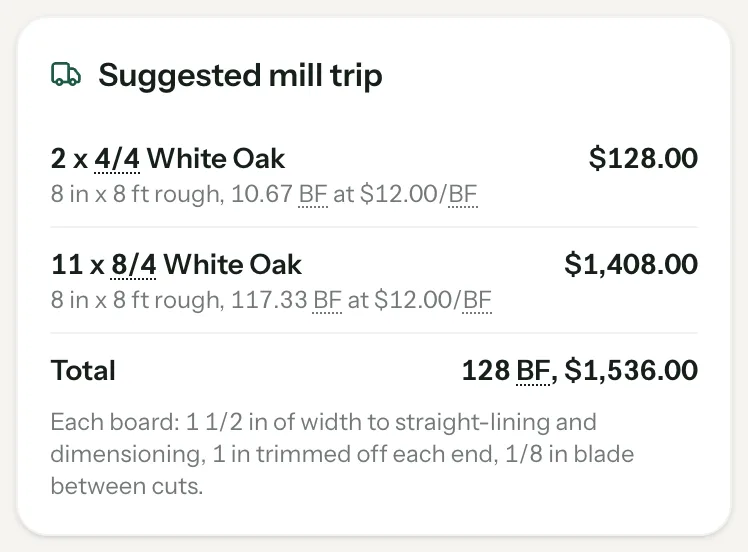
From the drawing to the lumber rack in four steps.
Approve the drawing
Your drawing has the parts and sizes. Nothing is figured until you approve it, so you're never buying off a draft.
Board feet, part by part
Each rough part gets its species and quarter, 4/4, 8/4 and up. Glue-ups are figured layer by layer.
The board plan
It lays every part onto the boards you actually buy, with your jointing allowance, end trim and blade kerf.
Onto the estimate
One tap puts the trip on the job's estimate as a draft, at your price per board foot. Nothing is sent.
You pay by the board foot. You buy it in random boards.
A board foot total tells you what you'll spend, not what to pull off the rack. Every board on the rack is a different width and length, and you have the sizes you usually grab. Tell Square Away once what you usually buy, and every job is planned on those boards.
- Your usual boards, set once in Settings, per species and quarter.
- One-off boards first. The mill has one wide 10/4 slab you want to use? Add it and it gets planned before anything else.
- Offcuts get used. A thinner part that fits in a thicker board's offcut comes out of it instead of buying its own stock.
- Real allowances. Width lost to the jointer, end trim, and kerf between every cut, all set to how your shop works.
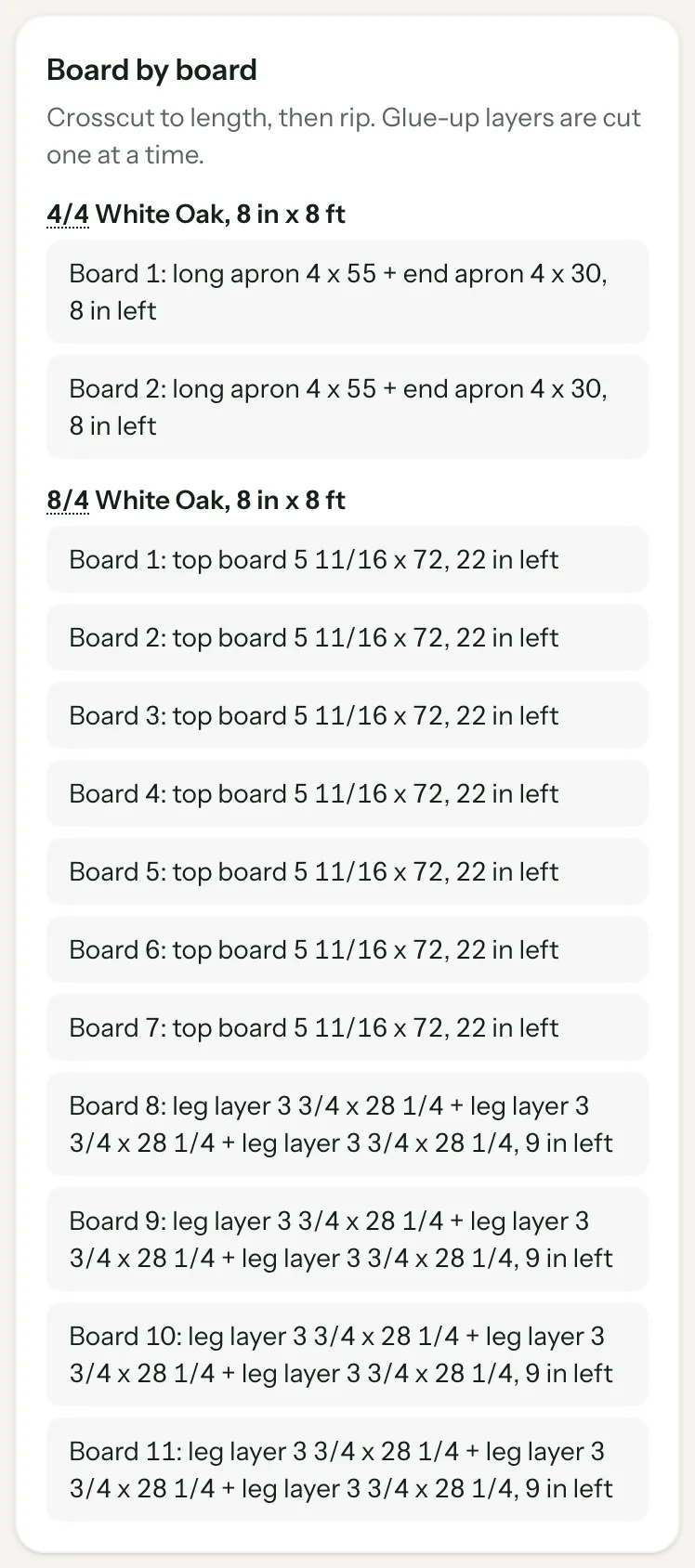
It tells you when a longer board saves money. In dollars.
After it plans your usual boards, it re-runs the job with the other sizes your mill carries. If 12 footers mean fewer boards and less waste, it says so with the number. On the sample table: "Save $64" with 12 ft 8/4, and "Save $48" with 10 in wide 4/4, because 10 in rips two aprons side by side where 8 in rips one. If your boards already fit the job, it says that too.
It's a suggestion, not an order. The mill decides what's on the rack, so you pick, tap "Plan again with these boards," and the cut list follows.
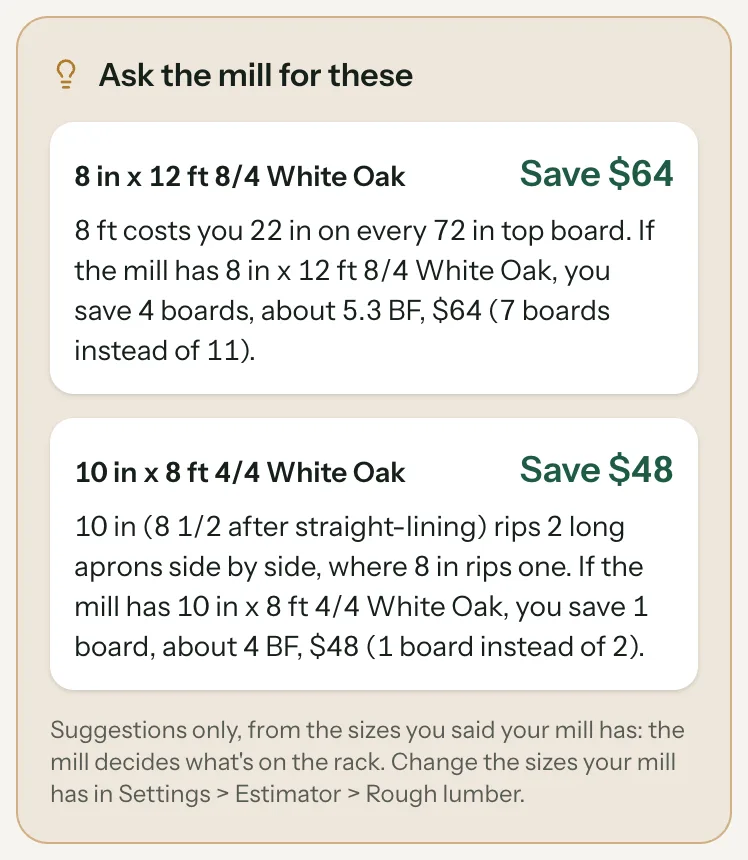
The cut list goes up on the shop TV.
Rough boards and sheet goods, one list. Send it to the shop TV and the whole crew works off it. Check parts off on your phone as they're cut and the TV keeps up, so nobody asks "did we cut the aprons yet?"
- Big type you can read from across the shop
- Parts checked off from the phone, live on the TV
- Print labels for every part if you'd rather tape them on
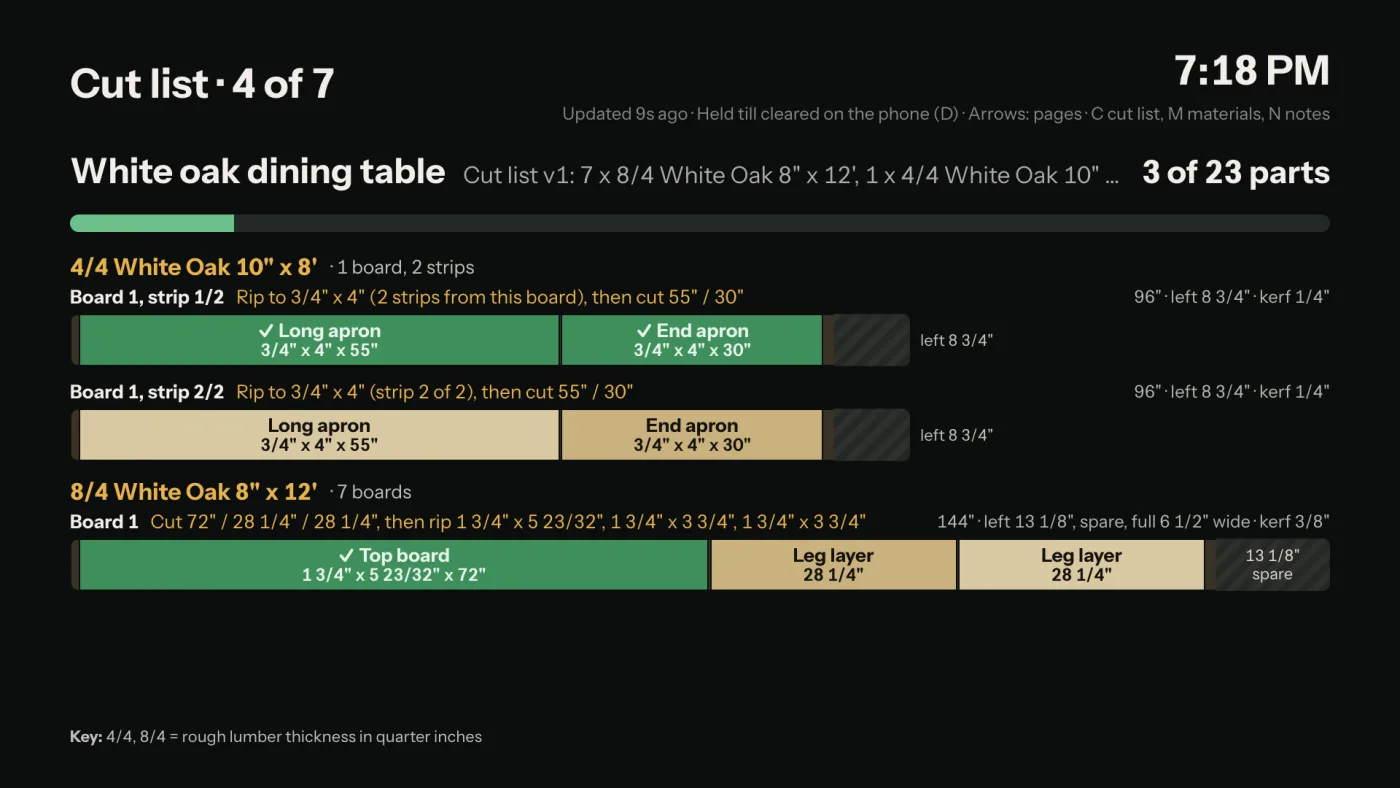
What it does, and what it leaves to you.
Board feet per part, the board plan, the mill trip, and the cost at your price, for every approved drawing.
It can't see the mill's rack. Sizes are suggestions, and the boards you actually bring home are what you plan with.
Your price per board foot comes from your Price Book. If it isn't set yet, it asks.
The trip lands on the estimate as a draft. You check it and you send it.
See it on one of your jobs.
Bring a drawing to the setup call and we'll run the board feet and the mill trip on it together.