How do I stop wasting plywood?
Plan every sheet before you cut it. Put all the job's parts on one cut list, lay them out on full sheets with your blade kerf counted, cut the biggest panels first, and only lock the grain where it shows. Then keep a list of usable offcuts so the next job uses them before you open a new sheet.
Most plywood waste happens before the saw starts: parts cut one at a time off whatever sheet is on top, and good offcuts that end up in the burn pile because nobody knew they were there.
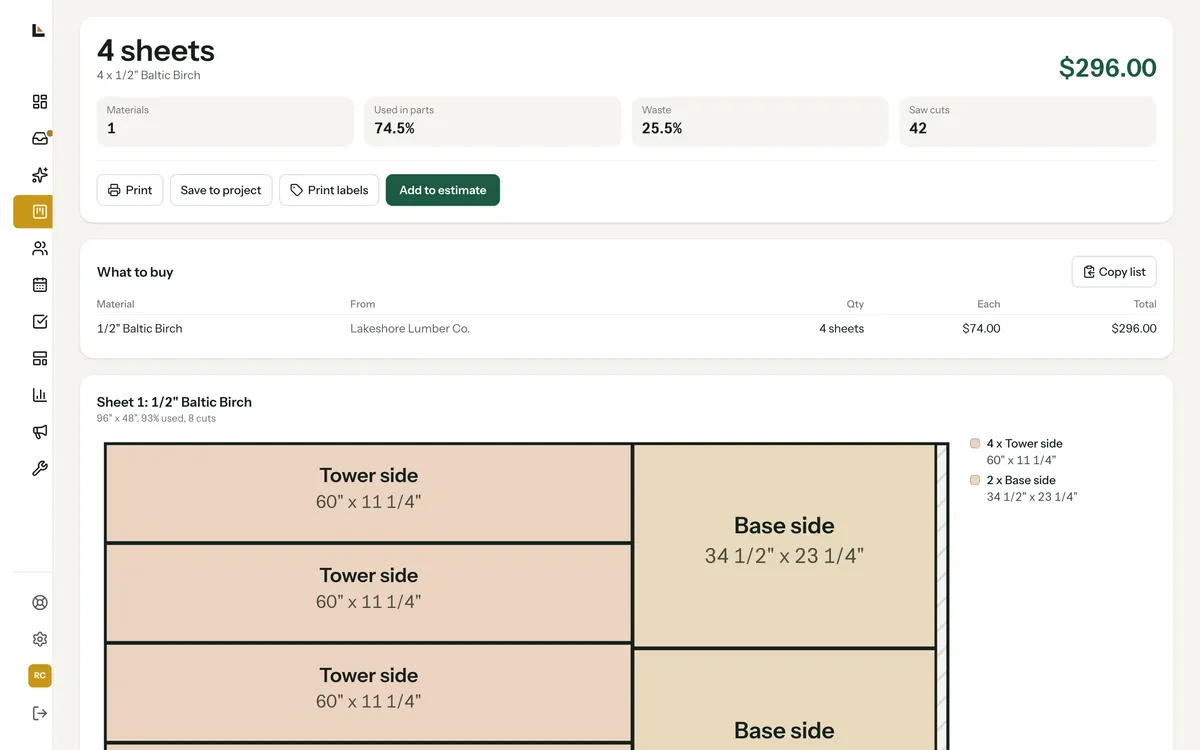
Getting more parts out of every sheet.
Put every part on one cut list.
The whole job, not one cabinet at a time. Finished sizes, counts, material and thickness for every part.
Count the kerf.
Most blades take 1/8 inch per cut and a thin kerf blade about 3/32. On a sheet with a dozen cuts that adds up, and a plan that ignores it comes up short at the last part.
Lock the grain only where it shows.
Let parts turn on the sheet when nobody will see the grain, like cabinet bottoms and hidden shelves. Every part you let turn opens up a better layout.
Trim the factory edges if yours come dinged.
Plan that trim cut in from the start so you're not stealing it from a part later.
Cut the biggest panels first.
Lay out and cut the large parts, then fill the gaps with small ones. Small parts fit around big ones, never the other way around.
Allow for edge banding.
Cut each banded part a little smaller so it finishes at the size on the drawing, not oversize by the banding.
Label every part.
A label with the job, the part and the size keeps the right piece going to the right box, and nothing gets recut by mistake.
Keep the offcuts worth keeping.
Pick a smallest size worth saving, write each one down, and use those first on the next job before you open a new sheet.
Plan my cuts lays out the sheets for you.
On the Shop and Crew plans, Plan my cuts lays every part on your sheets and boards, tells you how many to buy and draws every sheet so you know where each cut goes. You set it up the way your shop cuts:
- Blade thickness set once, plus trim the factory edges of sheets and trim each board end.
- Grain per part: Either way, Along the length or Along the width.
- Edge banding: type the finished size and mark the banded edges, and it cuts each part a little smaller so it finishes right.
- Print labels on Avery sheets with the job, part, sizes, material, banded edges and a grain arrow.
A list of what's leaning against the wall.
Turn on Keep track of my offcuts and the leftovers from each plan go on a list. Later plans can use them with Use my offcuts, and Update my offcuts takes the used pieces off when you're done cutting. Smallest leftover worth keeping starts at 12 inches, so slivers never clutter the list.
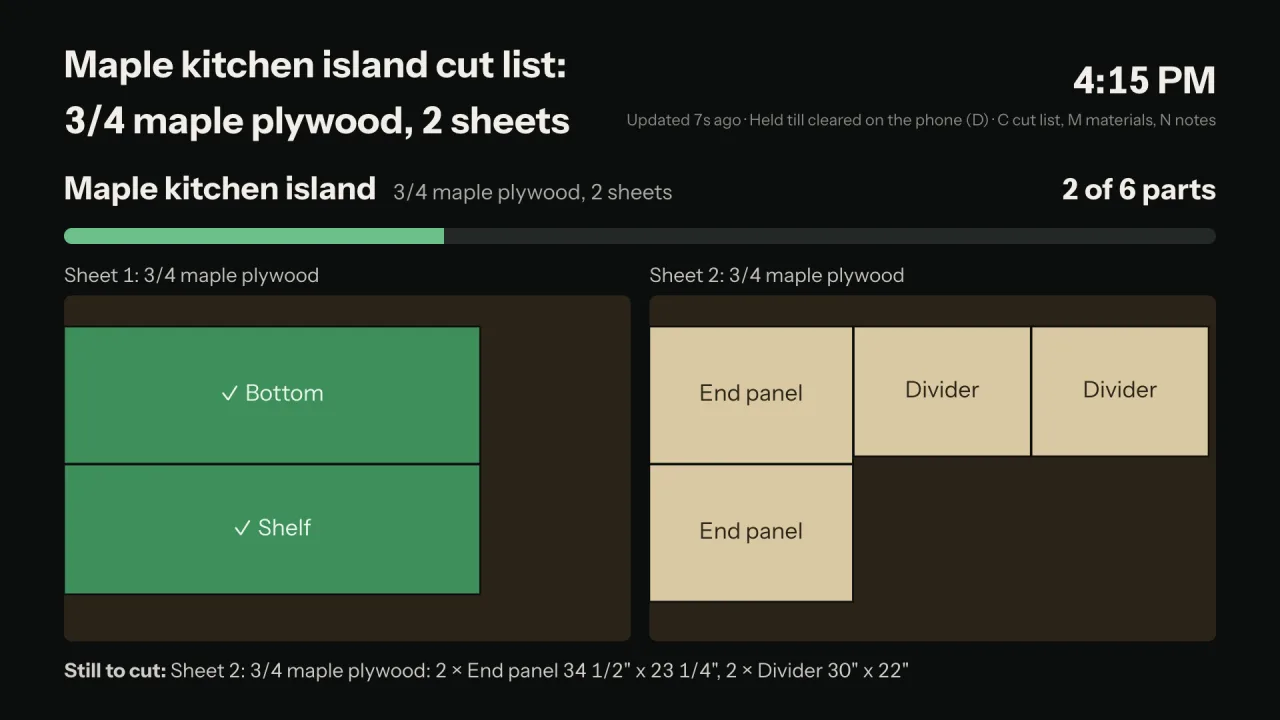
At the saw, open the cut list on your phone and tick parts off as you cut them, or send it to the shop TV.
What it does, and what it leaves to you.
It plans the cuts a table saw or panel saw makes.
It keeps the grain the way you mark each part. Leave a part on Either way only when the grain won't show.
Check for voids, dings and bow before you cut, the same as always.
The cut planner comes with the Shop and Crew plans.
More on plywood waste.
How much does the saw blade kerf matter on a sheet of plywood?
More than it looks. Most blades take 1/8 inch per cut, so a sheet with 12 cuts loses an inch and a half to sawdust. Plan without it and the last part on the sheet comes up short.
What should I do with plywood offcuts?
Pick a smallest size worth keeping, label each offcut with its size and material, and keep a list. Check that list before you open a new sheet. An offcut nobody knows about is waste.
Is it OK to rotate plywood parts on the sheet?
Yes, when the grain won't show, like cabinet bottoms, backs and hidden shelves. Keep the grain running the same way on anything that faces the room.
Plan one of your cut lists on the call.
Bring a job you're about to cut. We'll lay out the sheets with your blade and your price book, and print the labels.